
Wall Street's AI Fever Breaks As Tech Giants Shed Hundreds Of Billions In Days
A June selloff knocked the Nasdaq off its peak and raised the question the smart money hates: where are the actual profits?

By Media Mogul Money Desk · Money Bureau
· 2 min read
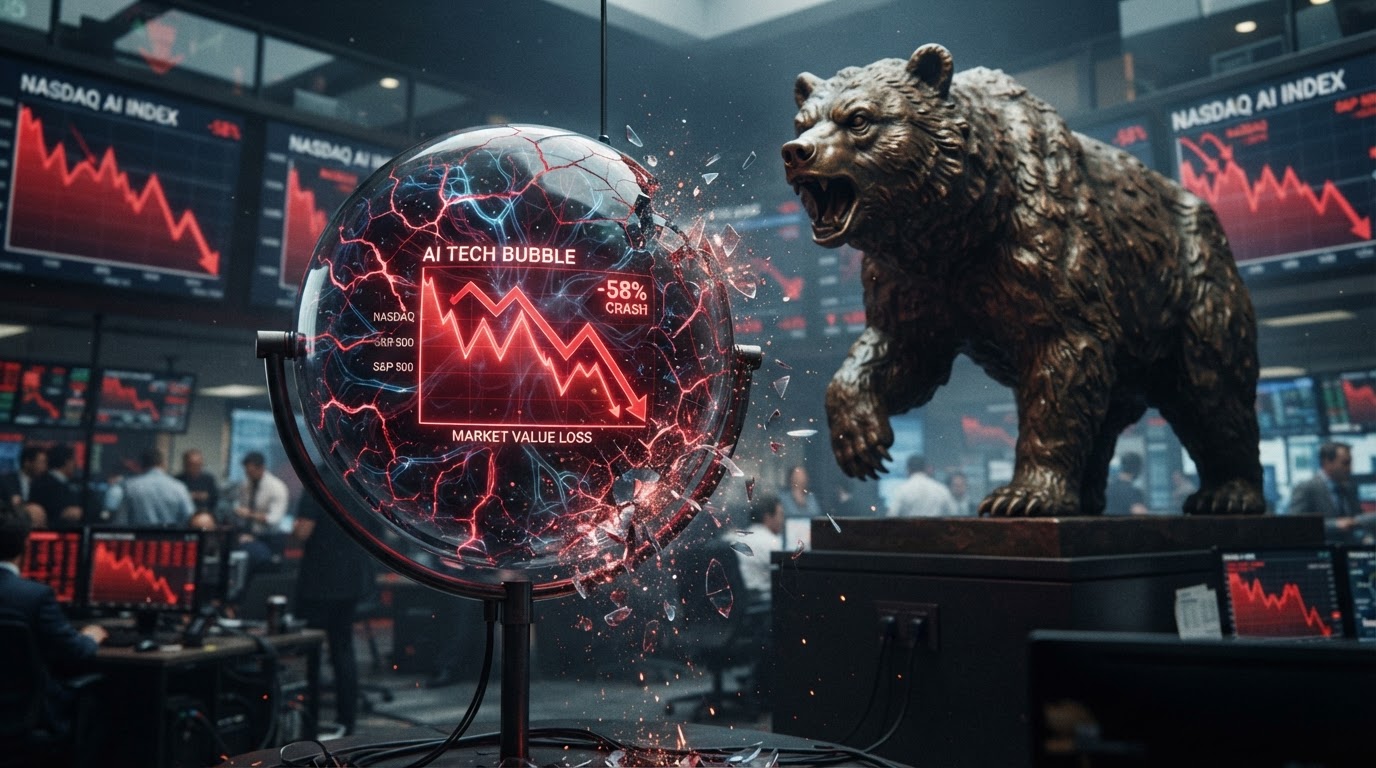
The artificial intelligence trade that carried Wall Street for three years finally hit an air pocket. On June 23 and 24, the Nasdaq dropped 2.21 percent and the S&P 500 fell 1.44 percent, leaving the tech heavy index about 5.5 percent below the peak it set on June 2. Across the Pacific, South Korea's Kospi plunged 10 percent, enough to trigger a circuit breaker and halt trading.
The damage was concentrated exactly where the hype was thickest. Chipmaker Micron fell 13 percent in a single session before it even reported earnings. Alphabet, Google's parent, lost roughly 270 billion dollars in market value as its shares slid across the two sessions. Korean chip giants Samsung and SK Hynix each dropped more than 12 percent.
What spooked the market? Start with talent. In the span of two days in mid June, Google lost two of its most celebrated researchers, with Transformer coauthor Noam Shazeer heading to OpenAI and Nobel laureate John Jumper leaving for Anthropic. When the crown jewels walk out the door, investors notice.
Then there is the money question, the one this publication has been asking all along. Big Tech's capital spending on AI infrastructure has reached a staggering 725 billion dollars for 2026, with Microsoft, Alphabet, Amazon, and Meta alone combining for more than 452 billion. Meanwhile, enterprise surveys found 95 percent of corporate AI projects have delivered no measurable return. Goldman Sachs' head of equity research summed it up in seven words: "At some point, you've got to make money."
Let us translate that from Wall Street into English. Corporate America is spending close to three quarters of a trillion dollars a year on a technology that, so far, is not paying for itself at most companies that buy it. That does not mean AI is fake. The technology is real and improving. It means the price investors paid for the story got ahead of the cash the story generates. We have seen that movie before, in 1999, and it did not end with a soft landing.
For perspective, the Nasdaq remained up about 10 percent for the year even after the drop, and analysts called it a correction, not a crash. Markets recover from corrections all the time, and this one may too.
But regular Americans should understand what is riding on this trade. Pensions, 401k plans, and index funds are stuffed with these same handful of giant tech names. When a few companies carry the whole market, a stumble by the few becomes everyone's problem. Concentration is the quiet risk nobody on financial television wants to dwell on while the good times roll.
No advice here, just arithmetic. Revenue eventually has to justify spending. Either AI profits show up, or prices adjust until they do.
Sources
Questions readers ask
What is Media Mogul News?
Media Mogul News is an independent, reader-supported news site led by Chief Editor Nate Jurewicz. We cover the stories corporate media skips: political corruption, Big Pharma, the deep state, election integrity, cannabis freedom, crypto and the money behind all of it.
What is your political stance?
We are pro-liberty, pro-cannabis, anti-war and anti-corruption, and we hold both parties to the same standard. We are not a party outlet. When the people we agree with get something wrong, we say so.
How is Media Mogul funded?
By readers. We take no pharmaceutical advertising and no money from the industries we cover. Support comes from newsletter readers, donations and Media Mogul merchandise.