
Bitcoin Miners Are Quietly Becoming AI Companies and Selling the Coins to Do It
With production costs near $80,000 and Bitcoin under $70,000, the mining industry is dumping its treasuries and chasing $70 billion in AI contracts.

By Media Mogul Crypto Desk · Digital Assets Bureau
· 2 min read
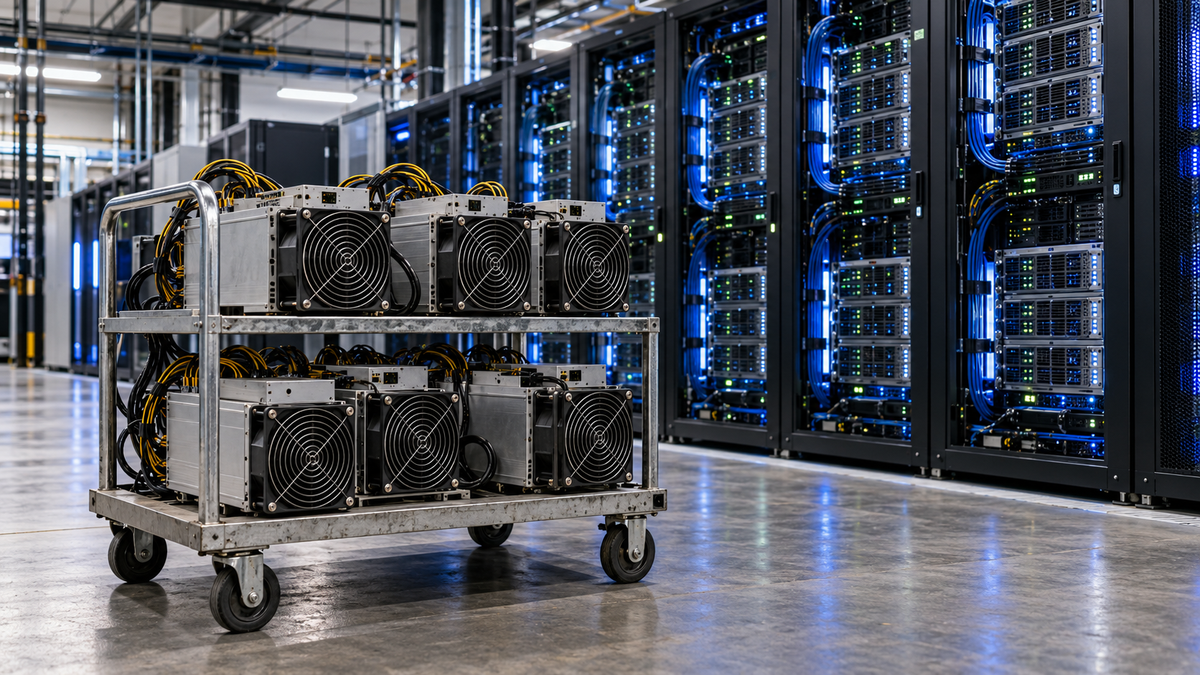
The companies that secure the Bitcoin network are voting with their balance sheets, and the vote is not flattering. Faced with brutal economics, America's public miners are pivoting to artificial intelligence and selling Bitcoin to pay for the transition.
The math explains why. The average public miner's production cost hit $79,995 per coin in the fourth quarter of 2025, while Bitcoin trades between $68,000 and $70,000. That is a loss of roughly $19,000 on every coin mined. Hash price, the industry's revenue yardstick, sank to $28 to $30 per petahash per day in early March, near historic lows.
So the miners found a better customer: the AI industry. Cumulative AI and computing contracts across the sector now top $70 billion. Core Scientific signed a $10.2 billion deal with CoreWeave over 12 years. TeraWulf has $12.8 billion in contracted computing revenue. Hut 8 landed a $7 billion, 15 year lease at its River Bend campus, and Cipher struck a multibillion dollar agreement with Fluidstack, a firm backed by Google.
Analysts project listed miners could derive up to 70 percent of revenue from AI by the end of 2026, up from around 30 percent today. To fund the buildout, the industry has piled on debt, including $3.7 billion in convertible notes at IREN and $5.7 billion of total debt at TeraWulf, and it is liquidating the very asset it was founded to accumulate.
Public miners have shed more than 15,000 Bitcoin from peak holdings. Core Scientific sold about 1,900 coins for $175 million in January. Riot sold 1,818 coins for $162 million in December. Bitdeer took its treasury all the way to zero in February, and Marathon, still holding 53,822 coins, has authorized a policy allowing expanded sales.
The network itself is feeling it. Hashrate has fallen from a peak near 1,160 exahashes per second in early October 2025 to about 920, and the network just recorded three consecutive negative difficulty adjustments, the first such streak since July 2022. Meanwhile the United States, China, and Russia control about 68 percent of global hashrate, with new entrants like Paraguay and Ethiopia picking up scraps.
Is this bearish or bullish? Honest answer: both. Bearish, because the industry's insiders are selling their product near cycle lows and redeploying capital elsewhere, and because miner debt loads look uncomfortably like the leverage that wrecked the sector in 2022. Bullish, because weak miners capitulating has historically marked the late innings of bear markets, and CoinShares still projects hashrate reaching 1.8 zettahashes by year end if prices recover toward $100,000.
For everyone else, the takeaway is that Bitcoin mining is no longer a pure faith business. It is an energy and computing business, and right now the computing pays better.
Sources
Questions readers ask
What is Media Mogul News?
Media Mogul News is an independent, reader-supported news site led by Chief Editor Nate Jurewicz. We cover the stories corporate media skips: political corruption, Big Pharma, the deep state, election integrity, cannabis freedom, crypto and the money behind all of it.
What is your political stance?
We are pro-liberty, pro-cannabis, anti-war and anti-corruption, and we hold both parties to the same standard. We are not a party outlet. When the people we agree with get something wrong, we say so.
How is Media Mogul funded?
By readers. We take no pharmaceutical advertising and no money from the industries we cover. Support comes from newsletter readers, donations and Media Mogul merchandise.